Kostat tengguang: Difference between revisions
No edit summary |
No edit summary |
||
| Line 19: | Line 19: | ||
== Museum holdings == | == Museum holdings == | ||
{{#get_db_data: | |||
db=my_db | |||
|from=ItemT | |||
|where=ChamName=18 | |||
|data=ItemTID=ItemTID,AccessionNumber=AccessionNumber,SiteTID=SiteTID | |||
}} | |||
{{#for_external_table:| | |||
* [{{{SiteURL}}} {{{AccessionNumber}}}] — {{{SiteName}}} | |||
|source=my_db | |||
|from=ItemT,SiteT,ChamoruNameT | |||
|data=AccessionNumber=AccessionNumber,SiteName=SiteName,ChamoruName=ChamoruName,SiteURL=ItemT.SiteURL | |||
|where=ItemT.SiteTID=SiteT.SiteTID AND ItemT.ChamName=ChamoruNameT.ChamoruNameTID AND ItemT.ChamName=13 | |||
|order by=ItemT.SiteTID,AccessionNumber | |||
}} | |||
== References == | == References == | ||
Revision as of 02:20, 13 April 2026
Kostat tengguang is a drawstring bag of varying size, generally taller than wide, plaited from åkgak leaves in a diagonal weave pattern. The drawstring at the top of the plaited bag is generally either twisted åkgak cordage, or round-weave åkgak cordage.
Uses
Kostat tengguang is a compound word coming from kostat (Spanish: costal [1] - n. sack, bag) meaning bag, and tengguang[2] meaning food taken with you.
History
Although the woven kostat tengguang is not used in modern times as a common way of transporting one's food, it is sometimes seen being used as a personal effects bag, betelnut basket, or a purse. Kostat tengguang come in many shapes and sizes, but generally square at the base, and tall. The weaving can start large and be split into halves or quarters and woven up, or it can start very small at around 1/8 in. The kostat tengguang is generally taller than it is wide. It's characteristic feature is that it has a drawstring of some material, either woven, braided, or twisted which is laced through the weaving just below the top which is used to close and secure the container.
Cultural significance
(to be added)
Gallery
-
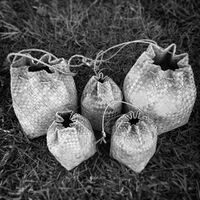 A group of kostat tengguang (lunch bags) woven from åkgak. The larger kostat tengguang on the left and the smaller one just in front of it were woven by Master Weaver Defunta Tan Elena Benavente from the island of Guam, and the remaining three to the right are reproductions of them woven by Chamoru weaver James C. Bamba.
 -
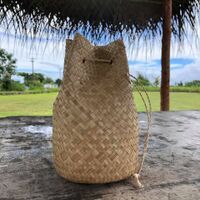 A round bottomed kostat tengguang photographed in Luta, CNMI. Woven by James C. Bamba


Museum holdings
- H18.1853 — Oakland Museum of California
- H18.1856 — Oakland Museum of California
- E419000-0 — The National Museum of Natural History (Smithsonian)
- E419001-0 — The National Museum of Natural History (Smithsonian)
- E419002-0 — The National Museum of Natural History (Smithsonian)
- E419003-0 — The National Museum of Natural History (Smithsonian)
- E419005-0 — The National Museum of Natural History (Smithsonian)
- E419007-0 — The National Museum of Natural History (Smithsonian)
- E419008-0 — The National Museum of Natural History (Smithsonian)
- E419009-0 — The National Museum of Natural History (Smithsonian)
- E419010-0 — The National Museum of Natural History (Smithsonian)
- E419011-0 — The National Museum of Natural History (Smithsonian)
- E419012-0 — The National Museum of Natural History (Smithsonian)
- E419013-0 — The National Museum of Natural History (Smithsonian)
- E419014-0 — The National Museum of Natural History (Smithsonian)
- E419015-0 — The National Museum of Natural History (Smithsonian)
- E419016-0 — The National Museum of Natural History (Smithsonian)
- E419019-0 — The National Museum of Natural History (Smithsonian)
- E419020-0 — The National Museum of Natural History (Smithsonian)
- E419021-0 — The National Museum of Natural History (Smithsonian)
- E419022-0 — The National Museum of Natural History (Smithsonian)
- E419026-0 — The National Museum of Natural History (Smithsonian)
- E419028-0 — The National Museum of Natural History (Smithsonian)
- E419068-0 — The National Museum of Natural History (Smithsonian)
- E419068-1 — The National Museum of Natural History (Smithsonian)
- E419068-2 — The National Museum of Natural History (Smithsonian)
- E419069-0 — The National Museum of Natural History (Smithsonian)
- E419070-0 — The National Museum of Natural History (Smithsonian)
- E419070-1 — The National Museum of Natural History (Smithsonian)
- E419070-2 — The National Museum of Natural History (Smithsonian)
- E419070-3 — The National Museum of Natural History (Smithsonian)
References
(to be added)
- ↑ Costal – Spanish to English Translation. SpanishDict.
- ↑ Tengguang – Chamoru-English Dictionary. Chamoru.info. Entry #7969.

