Påhong: Difference between revisions
From ChamoruWiki
Jump to navigationJump to search
mNo edit summary |
mNo edit summary |
||
| Line 16: | Line 16: | ||
'''Påhong''' (''Pandanus dubius'') | '''Påhong''' (''Pandanus dubius'') is a type of pandanus tree found along the coastlines and hillsides of the Mariana Islands. Known for its large, rounded fruit head and strong aerial roots, påhong grows in a variety of habitats and is often recognized as a familiar part of the island landscape. While not typically used for weaving, it plays an important role in protecting shorelines and providing shade and food for wildlife. | ||
== Cultural uses == | == Cultural uses == | ||
Latest revision as of 21:09, 20 September 2026
| Påhong | |
|---|---|
 |
|
| Adult female Pandanus dubius tree | |
| Scientific classification | |
| Kingdom | Plantae |
| Clade | Angiosperms |
| Clade | Monocots |
| Clade | Commelinids |
| Order | Pandanales |
| Family | Pandanaceae |
| Genus | Pandanus |
| Species: | dubius |
| Binomial name: | |
| Pandanus dubius Spreng. |
|
| Synonyms | |
No synonyms listed |
|
Påhong (Pandanus dubius) is a type of pandanus tree found along the coastlines and hillsides of the Mariana Islands. Known for its large, rounded fruit head and strong aerial roots, påhong grows in a variety of habitats and is often recognized as a familiar part of the island landscape. While not typically used for weaving, it plays an important role in protecting shorelines and providing shade and food for wildlife.
Cultural uses
- Seeds are extracted and eaten.
- Whole fruit heads are used as decorations during festivities.
- Leaves are occasionally used for coarse mats but not preferred.
Botanical notes
The following description is based on Stone’s 1967 study of Pandanus in the Marianas.[1]
- Leaves commonly well over 10 cm broad, thick, with a blunt tip and short acumen.
- Male inflorescences have yellow bracts.
- Cephalium is depressed-globose, commonly over 20 cm wide.
- Drupes mostly 1-celled with one vertical stigma, sometimes 2–4-celled with multiple stigmas.
- Strongly glaucous and somewhat purplish.
- Pithy structure with thin endocarp and large seeds, often 15 cm or longer.
-
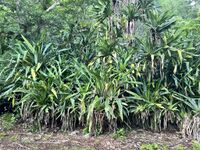 Påhong tree
 -
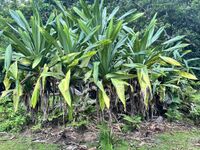 Påhong tree
 -
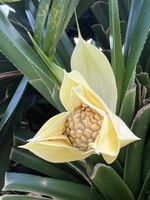 P. dubius female inflorescence
 -
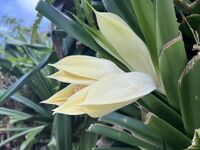 P. dubius female inflorescence
 -
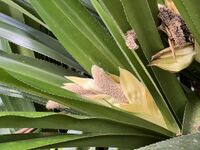 P. dubius male inflorescence
 -
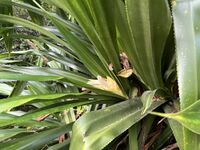 P. dubius male inflorescence
 -
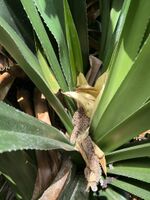 P. dubius male inflorescence
 -
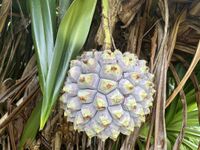 P. dubius fruit
 -
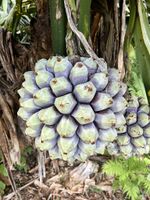 P. dubius fruit
 -
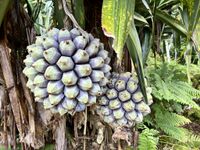 P. dubius fruit


